Roll-Off Truck vs. Dump Trailer: Which Equipment Should You Buy First?
| Comparison Factor | Roll-Off Dump Trailer | Dedicated Roll-Off Truck |
|---|---|---|
| Equipment Cost | $18,000 – $28,000 (Trailer only) | $75,000 – $140,000+ (Truck) |
| CDL Required? | No (If combo under 26,001 lbs GCWR) | Usually Yes (Class B Commercial) |
| Max Legal Payload | 3.5 – 5.0 Tons max | 8.0 – 14.0+ Tons |
| Drop / Load Cycle Time | 4 – 7 minutes (manual jacks/winch) | 60 – 90 seconds (in-cab hydraulics) |
| Residential Maneuverability | Exceptional (tight suburban cul-de-sacs) | Requires wide swing clearance |
Deciding between a roll-off truck vs dump trailer is the single biggest equipment fork in the road for anyone launching an independent waste hauling business. Choosing the wrong equipment can either bury your new company in unsustainable monthly debt or leave you with a setup that cannot keep up with commercial job sites.
A dedicated roll-off truck provides unmatched speed and power, but requires commercial CDL drivers and massive capital reserves. Meanwhile, modern gooseneck roll-off trailer systems have exploded in popularity among 1-to-3 truck operators because they deliver rapid cash flow with zero commercial driver license headaches. If you are structuring your business entity and capitalization plan, read our complete starting a dumpster rental business guide.
Here is an honest breakdown of the pros, cons, and financial realities of both setups to help you invest wisely.
1. Upfront Capital Cost: Dump Trailer vs. Roll-Off Truck
The financial entry barrier is the main reason many entrepreneurs begin with a trailer:
- • The Trailer Route ($50k–$85k all-in): If you already own a reliable 3/4-ton or 1-ton pickup, you only need to purchase a roll-off trailer (such as Texas Pride, MaxxD, or Roll-Off Trailers Inc.) for $18,000–$28,000 and a starter batch of 10–15 cans.
- • The Truck Route ($110k–$200k+ all-in): Even a used single-axle hooklift or tandem-axle cable hoist truck costs $65,000 to $120,000. Add insurance deposits and commercial tires, and your initial outlay is more than double.
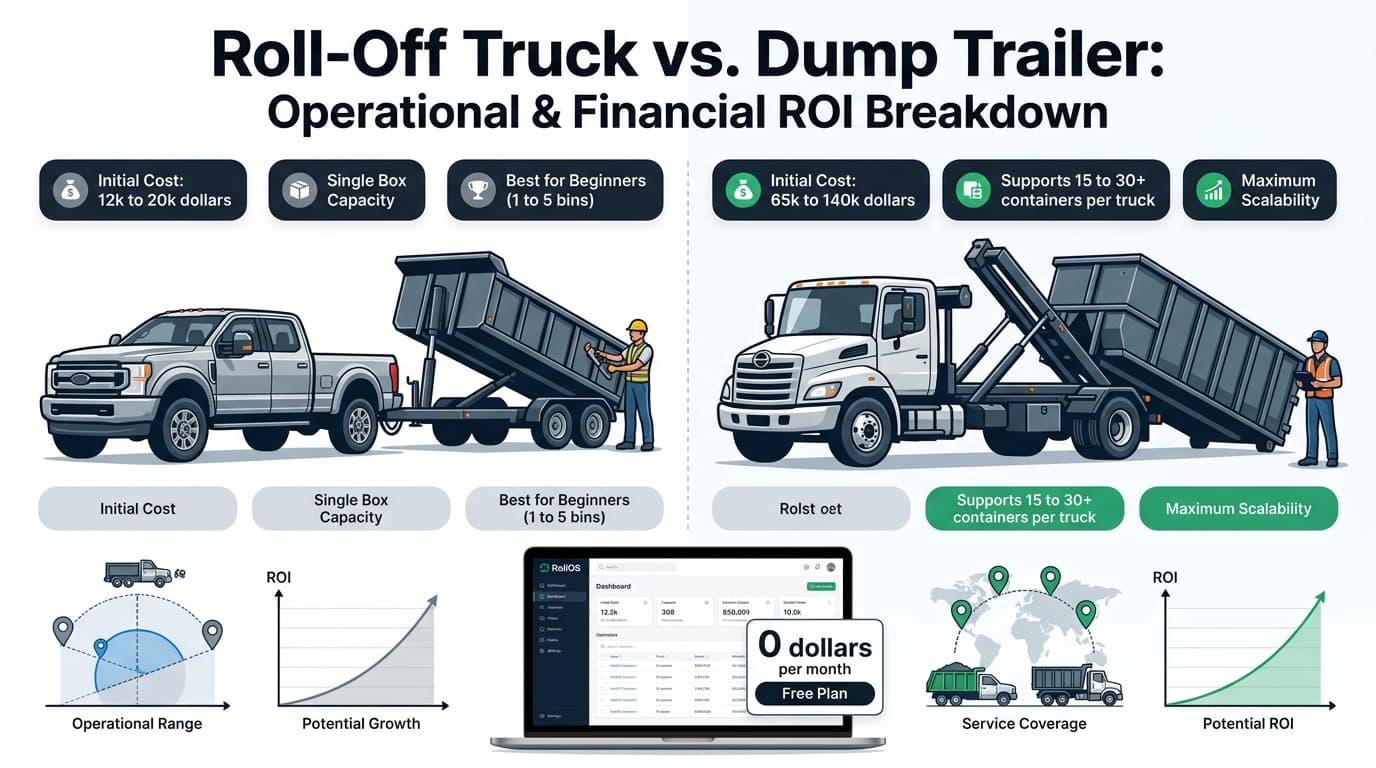
Roll-Off Truck vs. Dump Trailer: Operational & Financial ROI Breakdown
Compare upfront investment ($12k–$20k vs $65k–$140k), container capacity (1 box vs 15–30+ boxes), and scalability between pickup trailers and commercial roll-off trucks.
Dispatch Dumpsters from Any Truck or Trailer
Whether you run a 1-ton pickup with a dump trailer or a 10-truck commercial roll-off fleet, RollOS dispatches drivers with 1-tap SMS web links.
2. CDL Licensing and Driver Hiring Friction
Finding and keeping reliable commercial CDL drivers is one of the toughest challenges in the waste industry. CDL drivers command $28–$35+ per hour and are constantly recruited by national freight and waste carriers.
A non-CDL roll-off trailer setup (rated under 26,001 lbs GCWR) allows you to hire competent non-commercial drivers at $20–$24/hr, or run the rig yourself without maintaining a commercial driver logbook.
3. Maneuverability & Driveway Damage Prevention
A 35-ton tandem-axle roll-off truck can easily crack a residential concrete driveway or tear up sprinkler lines. That’s why many homeowners explicitly seek out driveway-safe mini dumpster companies.
Pickup-and-trailer setups exert significantly lower ground pressure, allowing you to back into tight suburban driveways, alleys, and historic downtown streets that large commercial trucks cannot legally enter. Regardless of equipment, always require customers to sign a driveway damage waiver contract before dropping any container.
Dispatch Drivers with Zero App Installs via RollOS
Whether you run 1 dump trailer or 5 tandem-axle roll-off rigs, dedicated roll off dumpster software keeps your dispatches organized. With our built-in dumpster driver routing software, dispatchers send daily stops directly to the driver’s phone via secure SMS web links—featuring 1-tap turn-by-turn navigation and delivery photo proof with zero app store downloads.
Frequently Asked Questions About Roll-Off Trucks vs. Trailers
Can you make good money with just a roll-off dump trailer?
Yes. Many six-figure dumpster rental businesses started with a single 1-ton truck and a roll-off trailer. With 10 to 12 bins, an owner-operator can net $4,000 to $8,000 per month without taking on high commercial truck payments or commercial insurance premiums.
What size truck is required to pull a roll-off dumpster trailer?
You will need at least a 3/4-ton truck (F-250 / 2500 series), but a 1-ton dually (F-350 / 3500 series) with a gooseneck hitch is strongly recommended. A 1-ton chassis handles the tongue weight of a loaded 20-yard container safely and prevents dangerous axle sway on the highway.
What is the main advantage of a roll-off truck over a trailer?
Speed and payload capacity. A hooklift or cable hoist roll-off truck can drop or load a container in under 90 seconds without leaving the cab or dealing with trailer stabilizer jacks. Trucks can also carry much heavier commercial payloads (up to 10–12 tons) that would overwhelm a trailer.
Do I need a CDL to haul a roll-off dump trailer?
In most states, no—as long as the Gross Combined Weight Rating (GCWR) of your truck plus the trailer is under 26,001 pounds. Keep in mind that DOT medical cards and commercial vehicle registrations still apply in many jurisdictions even without a CDL.
Build and Scale Your Hauling Fleet with RollOS
Free 24/7 online booking, visual drag-and-drop dispatch whiteboard, and automated scale billing.