How to Price Dumpster Rentals: The Complete Formula for Roll-Off Haulers
Never quote open-ended dumpster rentals without hard tonnage limits. A single heavy remodel load can wipe out your entire weekly profit at the transfer station.
Understanding how to price dumpster rentals is the single most critical factor determining whether your waste hauling company generates healthy 20%+ net margins or bleeds cash on fuel and tipping fees. For realistic revenue models and full P&L benchmarks across 1–25+ trucks, see our breakdown of dumpster rental profit margins.
When you deliver a 20-yard roll-off container, you are investing wear-and-tear on your truck, fuel, insurance, and tying up a $5,000 asset for several days. If a customer tosses 4 tons of plaster and wet tile into a container where you only budgeted for 2 tons, that extra disposal cost comes straight out of your pocket.
Here is the step-by-step formula independent operators use to price dumpster rentals accurately, maximize container turnover, and guarantee profitable hauls.
1. The 4 Pillars of Dumpster Rental Pricing
To set prices that guarantee profit on every haul, build your base price from these four cost components:
Fuel & Drive Time
Every drop involves 2 round trips (drop-off and pickup). If your service radius is 25 miles, that’s up to 100 miles of driving per rental. Budget $45–$75 for diesel and driver drive time.
Local Landfill Tipping Fees
Tipping fees vary drastically by region—from $35/ton in rural areas to $110+/ton in the Northeast. Your base price must include an allowance (e.g., 2 tons = $110 disposal cost).
Asset Depreciation & Insurance
Truck maintenance, tire wear, hydraulic fluid, and commercial insurance amount to roughly $35–$60 per pull.
Target Net Profit Margin
Target a clean $100 to $175 net profit on every standard 7-day haul before reinvestment.
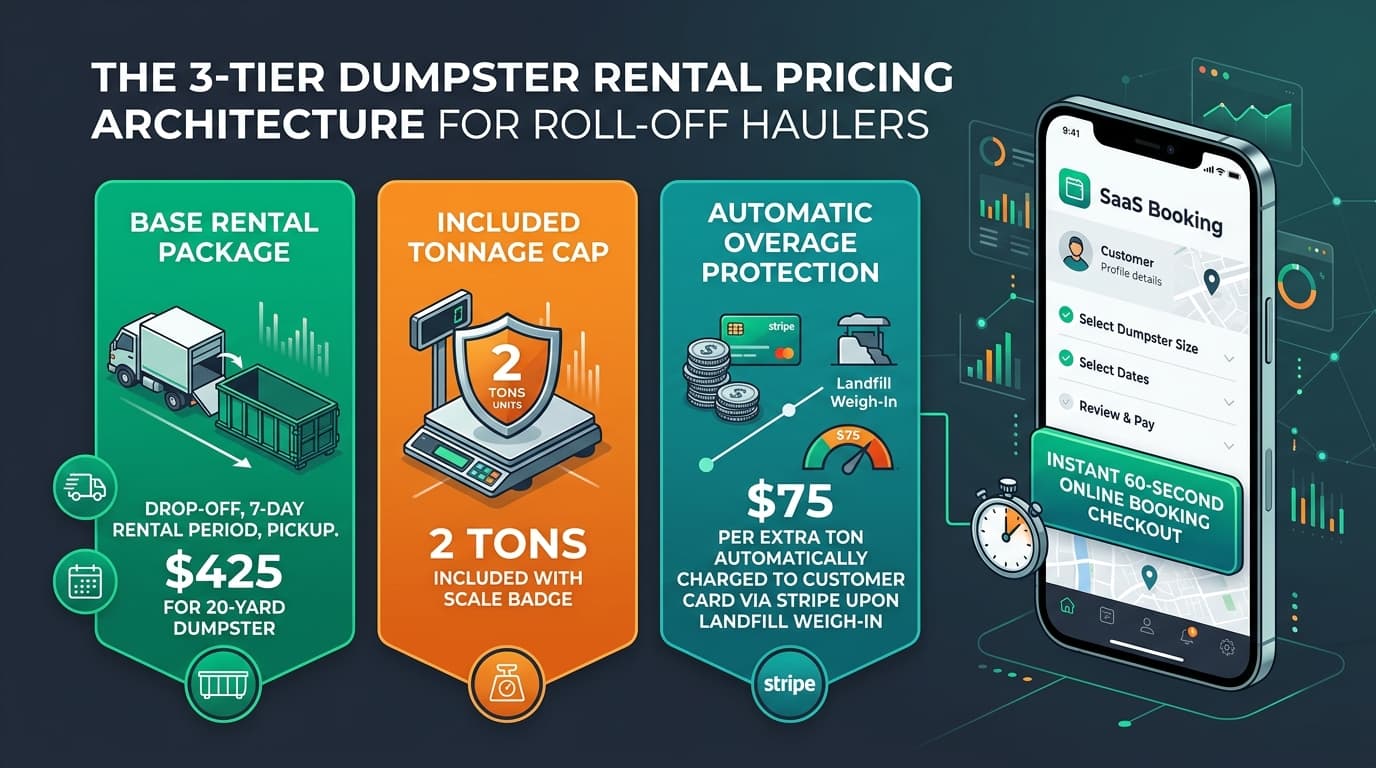
The 3-Tier Dumpster Rental Pricing Architecture for Roll-Off Haulers
Master the 3-pillar pricing model: base rental packages, protective included tonnage caps, and automated scale overage collection via Stripe.
Lock in Your Tonnage Rates and Get Paid Online
RollOS provides instant 60-second online customer booking with transparent pricing and automatic scale overage invoicing.
2. Dumpster Rental Price Averages by Size (10, 15, 20, 30 & 40 Yard)
Below are standard national pricing benchmarks for independent roll-off operators:
| Size | Base Price (7 Days) | Included Tons | Overage Rate |
|---|---|---|---|
| 10-Yard Bin | $325 – $425 | 1.0 – 1.5 Tons | $75 – $95 / ton |
| 15-Yard Bin | $375 – $475 | 1.5 – 2.0 Tons | $75 – $95 / ton |
| 20-Yard Bin | $425 – $550 | 2.0 – 3.0 Tons | $80 – $100 / ton |
| 30-Yard Bin | $525 – $675 | 3.0 – 4.0 Tons | $85 – $105 / ton |
| 40-Yard Bin | $650 – $850+ | 4.0 – 5.0 Tons | $90 – $110 / ton |
Calculate Your Tonnage Overage & Landfill Net Profits Instantly
Not sure how much to charge when a customer exceeds your weight limit? Use our free interactive dumpster tonnage calculator to simulate scale tickets, disposal surcharges, and customer invoices in seconds. Pair our calculator with dedicated dumpster tonnage billing software to charge excess landfill weight automatically to the customer's card on file.
3. How to Bill for Scale Overages Without Chasing Customers
The #1 cash flow killer for independent haulers is collecting money after the container has left the job site. Once a customer’s driveway is clean, they have zero urgency to pay an extra $180 for an overweight scale ticket.
If you bill contractors manually, download our free dumpster rental invoice template to present clear, itemized disposal charges. Even better, modern dumpster rental software for haulers eliminates manual billing entirely: your customer enters their credit card during online checkout and agrees to pre-authorized disposal charges. When your driver dumps the can and snaps a photo of the landfill scale ticket, the software calculates the exact overage and charges the card on file automatically.
Frequently Asked Questions About Dumpster Rental Pricing
How much should you charge per ton for dumpster overages?
Most independent haulers charge between $75 and $110 per ton for weight over the included limit. A safe rule of thumb is to take your local landfill tipping fee (e.g., $55/ton) and add a 35%–50% markup to cover truck wear, axle strain, and driver waiting time at the scale.
How many days should be included in a dumpster rental base price?
For residential homeowners, a 7-day rental period is the industry standard. For commercial contractors and roofers who turn dumpsters quickly, 3-day to 5-day rentals are common. Extra days typically range from $15 to $25 per day.
Should I charge customers up front or after pickup?
Always collect the base rental fee up front when the customer books online. Save their payment card securely on file via Stripe Connect so you can automatically bill for extra days and scale-ticket tonnage overages after dumping.
What is flat-rate vs. variable dumpster pricing?
Flat-rate pricing includes delivery, pickup, a set number of rental days (e.g., 7 days), and a set tonnage allowance (e.g., 2 tons). Variable pricing charges a lower base fee and bills the exact landfill disposal cost after dumping. Most residential customers prefer flat-rate pricing because it eliminates surprise bills.
Automate Your Container Pricing & Scale Invoices
Eliminate phone tag and capture bookings while you sleep. Free online booking widget, visual dispatch board, and scale ticket billing.